
The Taste That Changes Everything
When parents in my nutrition consultations tell me their baby "won't eat vegetables," I ask one question before anything else:
Are you using dashi?
In the vast majority of cases, the answer is no. And in the vast majority of cases, when they start using dashi - a simple broth made from kombu seaweed and dried bonito flakes - the problem resolves itself.
This is not a coincidence. It is umami.
Understanding umami is, for me, the single most useful piece of knowledge I can pass on to parents of young children. It explains why Japanese baby food tastes so good without adding anything that babies shouldn't have. And it explains why the flavour philosophy behind Japanese weaning is not just culturally interesting - it is scientifically sound.
What Umami Actually Is
Umami is the fifth basic taste - alongside sweet, salty, sour, and bitter.
It was identified in 1908 by Japanese scientist Kikunae Ikeda at the University of Tokyo. While studying kombu seaweed broth, Ikeda noticed that it had a distinctive, satisfying quality that couldn't be explained by the other four tastes. He isolated the compound responsible: glutamate, a naturally occurring amino acid. He named the taste "umami" - from umai (delicious) and mi (taste).
The word and the concept were largely unknown outside Japan for most of the 20th century. Western food science only began to take umami seriously in the 1980s and 1990s, when researchers identified specific taste receptors on the human tongue that respond to glutamate - confirming it as a distinct and universal taste, not just a Japanese cultural category.
Today, umami is fully recognised in food science worldwide. The receptors are real. The taste is real. And its implications for how we flavour food - especially food for babies - are significant.
Why Babies Are Born Umami-Sensitive
Here is something that surprised me when I first encountered it in the research: human breast milk is exceptionally high in free glutamate.
The glutamate concentration in human breast milk is roughly ten times higher than in cow's milk. It is, in fact, one of the highest concentrations of any amino acid in breast milk.
This means that from the very first feed, human infants are experiencing umami. Their palates are calibrated to it. When they later encounter umami-rich foods - dashi, tomatoes, mushrooms, fermented foods - they are meeting a familiar taste, one that signals nourishment and safety.
This is why Japanese baby food works so well. It meets the palate where it already is.
Dashi is, in essence, a concentrated and gentle umami delivery system. When you add dashi to a puree of sweet potato or spinach, you are not adding a foreign flavour - you are deepening a taste the baby already knows from the earliest days of life.
The Key Sources of Umami in Japanese Baby Food
Umami comes from glutamate and two related compounds - inosinate and guanylate. Different ingredients provide different combinations, and they work synergistically: combining glutamate with inosinate or guanylate multiplies the umami effect dramatically.
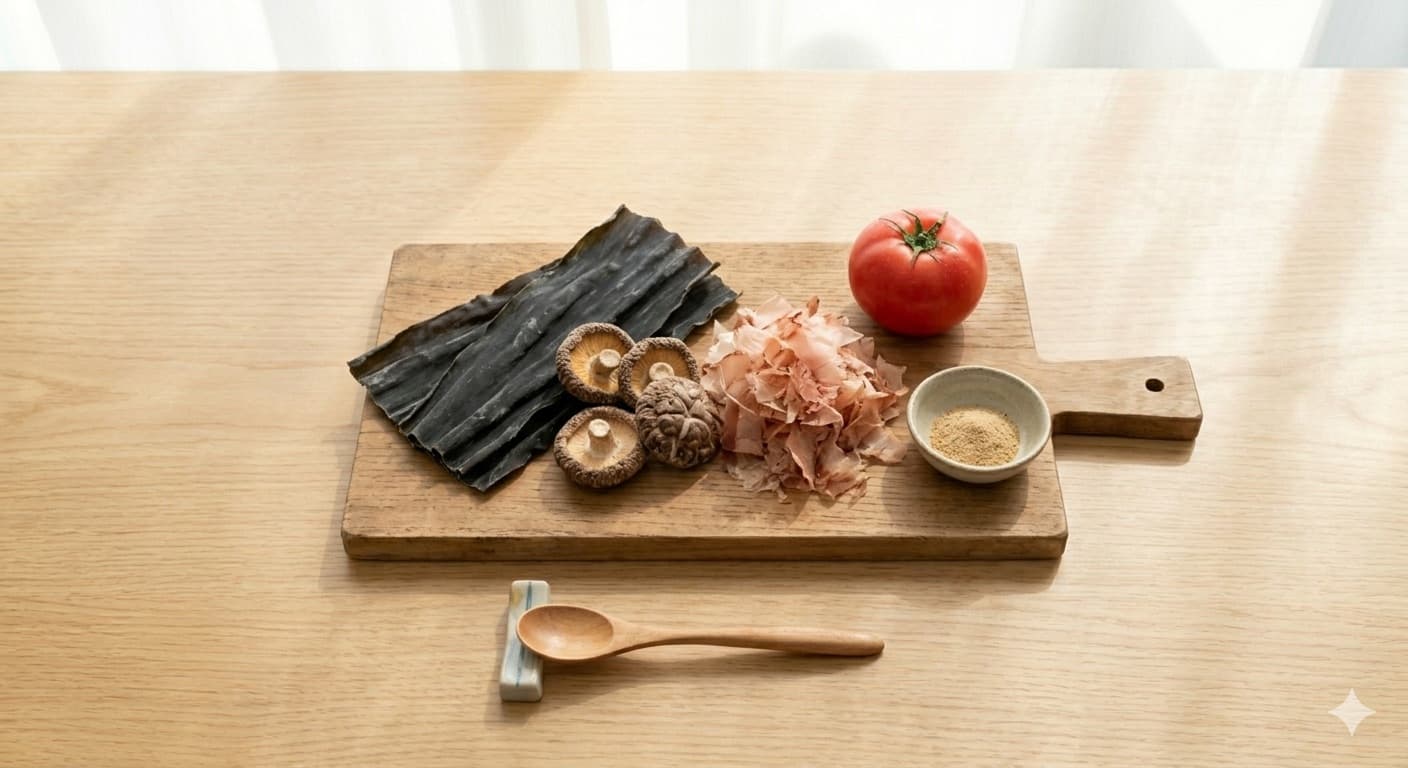
Kombu (kelp seaweed) The original umami ingredient. Kombu is very high in glutamate - up to 2,240mg per 100g, the highest concentration of any naturally occurring food. Kombu dashi (broth made by soaking kombu in water) is the gentlest, most versatile base for baby food. It adds depth without strong flavour and introduces a trace of iodine, which supports thyroid function.
Katsuobushi (dried bonito flakes) High in inosinate. Combined with kombu, katsuobushi creates the classic Japanese dashi that is the backbone of miso soup, cooked vegetables, noodle broths, and almost everything else in Japanese cooking. The glutamate-inosinate combination produces a synergistic umami effect that is far more powerful than either ingredient alone.
Shiitake mushrooms High in guanylate, particularly when dried. Shiitake dashi - broth made by soaking dried shiitake in water - is deeply savoury and very well suited to vegetarian baby food. The soaking water, a brownish-golden liquid, adds umami to any vegetable puree or soup.
Tomatoes Perhaps the most accessible umami ingredient for families outside Japan. Ripe tomatoes are naturally high in glutamate - a fact that explains why tomato-based sauces have a satisfying, complex flavour even when no other flavouring is added. Roasting concentrates the glutamate further.
Fermented ingredients Miso, soy sauce, and other fermented soy products are extremely high in glutamate as a result of the fermentation process. These are not suitable for babies under 12 months due to high sodium content - but for toddlers, a very small amount of miso adds significant nutritional value and umami depth.
Umami vs. Salt: Why the Distinction Matters for Babies
One of the most important functions of umami in baby food is that it reduces the need for salt.
Salt enhances flavour - but for babies under 12 months, the kidneys are not yet mature enough to process significant amounts of sodium. The recommended sodium intake for babies aged 7-12 months is around 370mg per day. Many commercial baby foods, and many home-cooked foods made with stock cubes or seasoning, contain far more than this.
Umami offers a different pathway to flavour. Research has shown that adding umami to low-sodium foods makes them more palatable and satisfying - comparable to adding significantly more salt. One study found that reducing salt by 30-40% in soup had no detectable impact on perceived flavour when umami was increased.
For baby food, this means: dashi-flavoured vegetable purees taste rich, satisfying, and complete without any salt at all. The glutamate provides the depth that salt would otherwise provide, through a completely different mechanism and with no sodium cost.
This is not a trick or a workaround. It is the original function of dashi in Japanese cooking - to provide depth of flavour that doesn't depend on salt or sugar.
Practical Umami for Baby Meals
You don't need to understand the chemistry to use umami effectively. Here is what matters practically:
For early-stage babies (5-6 months): Use kombu dashi as the liquid base for all vegetable purees. Soak a piece of kombu (about 10cm) in 500ml of cold water for 30 minutes to an hour, then remove. Use this liquid to cook vegetables or thin purees. It adds gentle umami with no sodium.
For middle-stage babies (7-8 months): Introduce kombu-and-katsuobushi dashi - the most flavourful of the basic dashis. Make it in batches, freeze in ice cube trays, and add one or two cubes to any puree or soft-cooked vegetable dish.
For late-stage babies (9-11 months): Dried shiitake soaking water can be added to vegetable dishes and soft-cooked grain dishes. Tomato becomes an ingredient rather than just a flavouring - cooked, soft tomato adds natural umami and sweetness together.
For toddlers (12+ months): A tiny amount of miso (a quarter-teaspoon stirred through a bowl of soup) introduces fermented umami and the gut-health benefits of probiotic foods. Soy sauce in very small amounts can season stir-fried vegetables.
A Note on Glutamate Concerns
Some parents ask about MSG - monosodium glutamate - after reading concerns about it online. It is worth clarifying what the evidence actually says.
MSG is the isolated, crystalline form of glutamate - the same compound found naturally in kombu, tomatoes, and parmesan cheese. The scientific consensus, based on decades of research, is that glutamate from MSG is metabolised identically to glutamate from natural food sources. The "MSG symptom complex" described in older reports has not been consistently reproduced in controlled studies.
Natural umami sources - kombu, bonito, shiitake, tomato - are the form most appropriate for babies, not because natural glutamate is chemically different from MSG, but because they come with additional nutrients, minerals, and flavour complexity that enriches the baby's food and broadens their palate.
The principle is simply this: choose whole ingredients over isolated compounds, particularly for young children whose relationship with food is still forming.
The Deeper Point
Umami is not just a flavour trick. It is a window into why Japanese food tastes the way it does, and why it works so well for young children.
When you make dashi for a baby, you are doing something ancient and something scientifically precise at the same time. You are providing a taste they already know from their first weeks of life. You are giving depth to plain vegetables without adding anything their body isn't ready for. You are building a palate that will recognise and enjoy real, flavourful food for the rest of their life.
That is what umami, understood properly, makes possible.
Related Articles
- The Ultimate Guide to Baby Dashi Stock
- Ichiju Sansai: The Japanese Meal Formula That Makes Nutrition Simple
- Japanese Baby Food Seasonings: What to Use and When
Yumi is a registered dietitian and mother who uses dashi as the foundation of all her baby food. She has worked with families across Japan on introducing umami-rich foods from the earliest stages of weaning.
Sources:
- Ikeda K., "New seasonings," Chemical Senses, 2002 (translation of original 1908 paper)
- Ninomiya K., "Natural occurrence of umami," Food Reviews International, 1998
- Masic U. and Yeomans M.R., "Umami flavor enhances appetite but also increases satiety," American Journal of Clinical Nutrition, 2014
- Shigemura N. et al., "Glutamate in human breast milk," Journal of Nutritional Science and Vitaminology, 2013
- Rolls B.J. et al., "Umami and the factors affecting the palatability of low-salt food," International Journal of Food Science and Nutrition, 2010
- WHO, "Sodium intake for adults and children," World Health Organization, 2012