
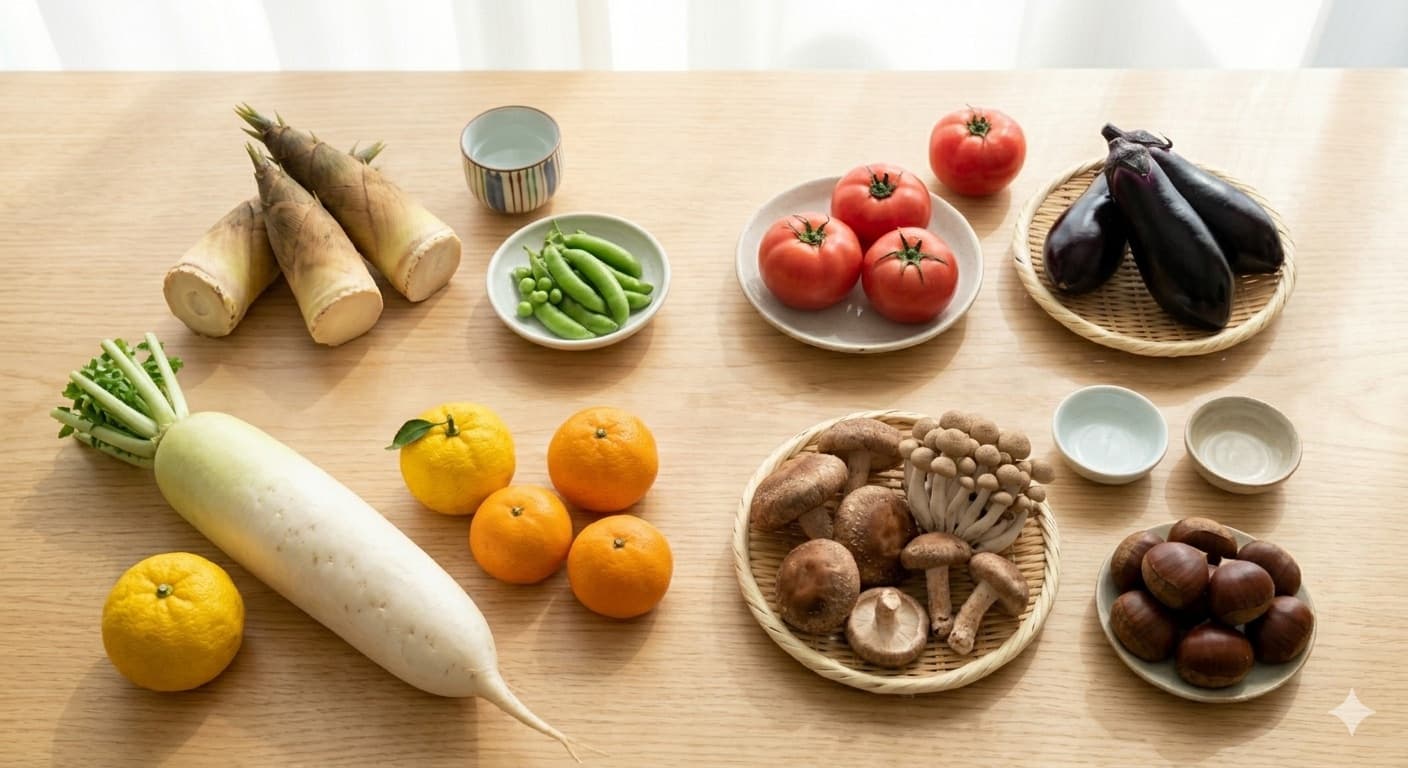
The Food UNESCO Decided to Protect
In 2013, washoku - traditional Japanese cuisine - was added to the UNESCO Intangible Cultural Heritage of Humanity list. It joined flamenco, Mongolian traditional music, and Mediterranean diet on a list designed to protect cultural practices that embody something irreplaceable about how human communities live.
What did UNESCO see in washoku that warranted this recognition?
Not a specific dish or a set of recipes. What UNESCO recognised was a philosophy of eating - one organised around four principles:
- A diverse diet with nutritional balance based on the natural flavours of ingredients
- Exceptional variety reflecting the seasons and regional landscape
- Expression of natural beauty and the changing of seasons
- Deep relationship with annual events and celebrations
Seasonality appears three times in these four principles. It is not incidental. It is the point.
What Seasonality Means in Japan
Japan has four clearly defined seasons, each with its own foods, colours, smells, and cultural associations. This is not metaphorical. The seasonal structure of Japanese food is precise, detailed, and deeply embedded in everyday life.
The concept of shun (旬) - the peak season of an ingredient, the brief period when it is at its most flavourful and nutritious - shapes how Japanese people think about what to eat and when. A piece of fish, a bundle of greens, a type of mushroom: each has its shun, and eating it at that moment is considered not just pleasant but respectful - respectful of the ingredient, of the natural world that produced it, and of the meal.
Spring brings bamboo shoots (takenoko), young burdock root, rapeseed blossoms (nanohana), and new-harvest tea. Flavours are delicate, fresh, and green.
Summer brings edamame, cucumber, shiso, corn, tomatoes, and myoga ginger. Meals shift toward cold preparations - chilled noodles, pickled vegetables, lightly dressed salads.
Autumn is the richest season for Japanese cooks: matsutake mushrooms, Pacific saury (sanma), sweet potatoes, chestnuts, persimmons, and the first new-harvest rice. Autumn foods are warming, earthy, and deeply satisfying.
Winter brings root vegetables - daikon radish, lotus root, burdock, turnip - along with winter citrus (yuzu, mikan), oysters, and the ingredients for nabe (hot pot). Meals are warming, long-cooked, and centred on comfort.
These are not rigid rules. They are rhythms. Japanese cooks learn them through childhood experience - noticing what appears at the market, what is served at school lunch, what their grandmothers make in each season - and carry that knowledge through life.
Seasonality in School Lunch
As a nutrition teacher planning school lunch menus in Saitama, seasonality was one of the frameworks I worked within every single month.
Japanese school lunch guidelines from the Ministry of Education explicitly recommend that menus reflect seasonal and regional ingredients. This is not optional guidance - it is part of what school lunch is understood to accomplish: to teach children about the food cycle of the natural world around them.
In April, bamboo shoots appeared in miso soup and rice dishes. In June, ajisai (hydrangea) themed desserts appeared alongside seasonal vegetables. In September, the first mention of autumn foods - sweet potato, chestnut - would land in the menu and prompt classroom conversations about why autumn tasted different from summer.
I watched children notice these patterns. They began to ask questions - "Is this a winter vegetable?" "Why do we have this now and not in summer?" - that told me the education was working. They were building an understanding of food that extended beyond their plate to the world that produced it.
This is what washoku transmits, and what seasonal school lunch reinforces: food is not an abstract product. It comes from a place, a time, and a living system.
Why Seasonal Eating Is Better Nutritionally
Beyond culture, seasonality has a nutritional rationale that is worth understanding.
Produce harvested at peak ripeness - at shun - has significantly higher nutrient content than the same produce harvested early and ripened off the plant during transport. Vitamin C in tomatoes, for example, is substantially higher in vine-ripened summer tomatoes than in tomatoes grown in controlled environments and harvested in January.
The seasonal variety that washoku demands also produces dietary diversity in ways that are difficult to achieve when eating the same crops year-round. Different seasons bring different vegetables, which contain different vitamins, minerals, and phytonutrients. Eating seasonally across the year ensures exposure to a genuinely broad range of nutrients.
There is also emerging research on the relationship between seasonal variation in diet and the gut microbiome. A 2019 study tracking members of a traditional community found that the gut microbiome composition shifted significantly with the seasons - with greater microbial diversity during periods of more varied food availability. The microbiome, it appears, thrives on the same seasonal variation that traditional food cultures have always practised.
Washoku for Babies: Starting with the Season
For families weaning babies onto solid food, seasonality offers a simple and nutritionally sound framework: start with what is in season where you are.
Peak-season produce is more flavourful, more nutritious, and often more affordable than out-of-season alternatives. For babies learning to eat, flavour matters more than many parents realise - not because babies need excitement, but because flavour is information. A baby eating a sweet, ripe summer tomato is building associations between sweetness and tomatoes that will last a lifetime. A baby eating a flavourless January tomato is building different associations.
Japanese baby food has traditionally used seasonal vegetables as its backbone - precisely because seasonal vegetables in Japan are excellent: flavourful, soft when cooked, naturally sweet, and available in variety. The rotation of vegetables through the seasons naturally produced dietary diversity and broad palate development without anyone having to plan for it.
For families outside Japan, the same principle applies: follow the season at your local market. What is plentiful, cheap, and fragrant is almost always in season. Start with those things. Build from there.
Washoku and Celebration: Food as Cultural Calendar
Washoku's relationship with seasonality extends into Japan's calendar of annual celebrations. Specific foods mark specific moments in the year, and these foods are introduced to children as part of cultural education.
Osechi ryori - the elaborate lacquered boxes of New Year's food - each contain dishes with symbolic meanings: sweet black beans (kuromame) for health, herring roe (kazunoko) for fertility and a good harvest, lotus root (renkon) for a future with clear vision. Toddlers are introduced to osechi as a tasting experience long before they understand the symbolism. The tastes become associated with the feeling of New Year - family, celebration, beginning.
Hinamatsuri (Girls' Day, March 3rd) brings hishi mochi - diamond-shaped rice cakes in pink, white, and green. Tanabata (July 7th) brings cold noodles. Otsukimi (moon-viewing, September) brings tsukimi dango - rice dumplings shaped like the full moon.
These are not decorative traditions. They are a food calendar that children absorb through their senses - and that connects what they eat to the rhythm of the year, the landscape, and the community they belong to.
This is what UNESCO recognised in washoku: not just a cuisine, but a living relationship between people, food, and the natural and cultural world around them.
Bringing Washoku Seasonality Home
You don't need to be in Japan to practice this. The core of washoku's seasonal philosophy is available to anyone who pays attention to what is growing.
Shop seasonally. Farmers markets, farm boxes, and the seasonal sections of good grocery stores show you what is at shun right now where you are. Prioritise these over imported, year-round produce.
Notice the flavour. Taste summer tomatoes against winter ones. Taste spring asparagus in April against asparagus in November. Teaching children to notice this difference is the beginning of seasonal awareness.
Let the season guide the menu. Rather than deciding what to cook and then buying the ingredients, try reversing the process occasionally: see what is at its best in the market this week, and let that determine the meal. This is how Japanese home cooks have always approached the question.
Mark the seasons with food. Even one or two seasonal food traditions - strawberries at the start of summer, root vegetable soup in winter - give children an experiential sense of the year that runs through food. These memories last.
The great gift of washoku is not any particular dish or ingredient. It is the habit of noticing where food comes from, when it arrives, and what that means. In a world where the same produce is available at the same temperature year-round in every supermarket, that noticing is a form of cultural resistance - and, nutritionally, a form of genuine care.
Related Articles
- What Is Shokuiku? Japan's Food Education Philosophy Explained
- Ichiju Sansai: The Japanese Meal Formula That Makes Nutrition Simple
- Umami and Baby Food: Why Japan's Fifth Taste Is Perfect for Young Palates
Yumi is a registered dietitian who grew up within the seasonal rhythms of Japanese cooking, and who brought that understanding into five and a half years of school lunch planning.
Sources:
- UNESCO, "Washoku, traditional dietary cultures of the Japanese," Intangible Cultural Heritage list, 2013
- Ministry of Education, Culture, Sports, Science and Technology (MEXT), "School Lunch Act and Guidelines," Japan, 2008
- Rickman J.C. et al., "Nutritional comparison of fresh, frozen, and canned fruits and vegetables," Journal of the Science of Food and Agriculture, 2007
- Sonnenburg J.L. et al., "Diet-induced alterations in gut microflora contribute to lethal pulmonary damage in TLR2/TLR4-deficient mice," Cell Host and Microbe, 2016
- Smits S.A. et al., "Seasonal cycling in the gut microbiome of the Hadza hunter-gatherers of Tanzania," Science, 2017
- Rauber F. et al., "Ultra-processed food consumption and chronic non-communicable diseases-related dietary nutrient profile in the UK," Nutrients, 2018