
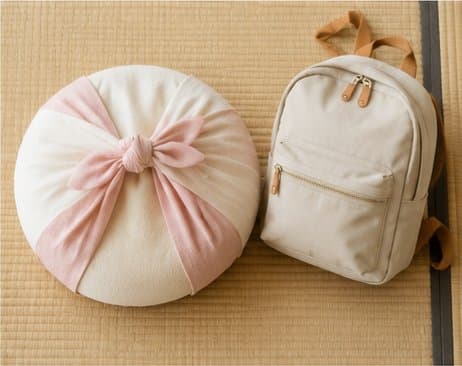
A Baby, a Birthday, and a Very Large Rice Cake
In Japan, a child's first birthday comes with a delightfully unusual tradition: the baby is asked to carry, pull, or simply sit beside a rice cake almost as heavy as they are. This is issho mochi - and like so much of Japanese food culture, it turns on a piece of beautiful wordplay.
The Meaning and the Wordplay
The tradition rests on a pun. An "issho" (一升) is a traditional unit of volume - about 1.8 litres, made from roughly 1.8 kilograms of rice when pounded into mochi. But "issho" is also a homophone for 一生, meaning "a whole lifetime."
So a rice cake made from one issho of rice becomes a wish that the child will "never want for food for their entire life" and will live a long, full, and stable life. The roundness of the mochi also symbolises harmony and a smooth, complete life.
The cake is often carried on the baby's back in a furoshiki cloth or a small backpack, or the baby is encouraged to stand or step with it. The weight - around 1.8kg against a one-year-old - means most babies wobble, sit down, or burst into tears, which is considered perfectly auspicious however it unfolds.
What If the Baby Falls Over?
Here is the charming part: there is no wrong outcome. Different regions read the result in their own favourable way.
- If the baby cannot stand under the weight, some traditions say the child will stay close to home and care for the family - a blessing.
- If the baby walks too easily, some regions actually worry the child may leave home early, and so prefer a wobble.
- A tumble is laughed off as warding off misfortune.
The ceremony is designed so that whatever happens, the family can smile and read good fortune into it. That generosity of interpretation is part of its warmth.
Erabitori: Choosing the Future
Issho mochi is often paired with a second custom called erabitori (or eranbi). Several objects are placed in front of the baby, and whichever they reach for first is said to hint at their future:
- A calculator or coin - good with money, business sense
- A pen or brush - a scholar, skilled with words
- Chopsticks or a spoon - never short of food, perhaps a cook
- A ruler - a sense of fairness, or a large home
It is, of course, just a game - but a joyful one, and it photographs wonderfully.
An Important Safety Note: Mochi Is Not for the Baby to Eat
This matters enough to state plainly. Issho mochi is a symbolic ceremony - the baby carries or touches the rice cake, but must not eat it.
Mochi is one of the most dangerous choking foods that exists. Its sticky, dense texture can mould to and block a small airway, and it causes serious choking incidents in Japan every year, including in adults. A one-year-old should never be given mochi to eat. Many Japanese guidelines recommend avoiding mochi entirely until around age three to four, and only then in tiny pieces under close supervision.
Enjoy the symbolism fully - and keep the actual rice cake well out of the baby's mouth. For more, see our choking hazards guide.
Celebrating the First Birthday with Food the Baby Can Eat
For the actual birthday meal, a one-year-old is usually in Stage 4 of weaning, eating soft family-style foods. Lovely, safe ways to celebrate include a baby-friendly "cake" made from layered okayu or soft rice, mashed potato, and fruit, or a small spread of favourite foods cut to a safe size. The festive rice cake stays symbolic; the birthday plate is something they can actually enjoy.
A Note From My Own Experience
We did issho mochi for my daughter's first birthday, strapping a cloth-wrapped rice cake to her back while every grandparent hovered with a phone camera. She took two proud steps, sat down hard, and looked around at us as if to ask what on earth we wanted from her.
Everyone cheered anyway - because in this tradition, there is no failing. Then we very deliberately took the mochi away, set it on a high shelf, and gave her the soft rice-and-fruit "cake" I had made instead. She buried both hands in it. That contrast - the ceremonial cake she carried and the real food she devoured - felt like the whole of parenting in one afternoon.
What to Read Next
- Choking Hazards in Baby Food - A Stage-by-Stage Safe Foods Guide
- Stage 4 Baby Food - The Japanese Approach to 12-18 Month Feeding
- Okuizome: Japan's 100-Day First Meal Ceremony for Babies
- Washoku and Seasonality: How Japan's Food Culture Follows the Harvest
Yumi is a registered dietitian (管理栄養士) and certified school nutrition teacher (栄養教諭) with 7.5 years of experience planning school lunches in Japan. She is now a first-time mother navigating rinyushoku with her own daughter, applying everything she has learned - and discovering how different it is when the baby is yours.
Sources:
- Japanese folklore and cultural references on issho mochi (一升餅) and erabitori (選び取り)
- Consumer Affairs Agency, Japan, data on mochi-related choking incidents
- Ministry of Health, Labour and Welfare, Japan. Enyuushoku Shien Guide (Weaning Support Guide), 2019