
Why This Guide Matters
Choking is one of the fears that follows new parents through every stage of weaning, and rightly so - it deserves real attention. At the same time, fear can lead to either of two unhelpful extremes: avoiding so many foods that meals become limited and bland, or not realising that a few specific, very common foods carry meaningfully higher risk and deserve real caution or delay.
This guide is meant to give you a clear, practical map: what to avoid, what to modify, and what is genuinely safe at each stage - specifically within the context of Japanese home cooking and traditional foods.
What Makes a Food a Choking Risk
In general, foods are higher risk when they are:
- Round, firm, and a similar size to a baby's airway - whole grapes, cherry tomatoes, whole nuts
- Hard and do not soften with chewing - raw carrot or apple in chunks, whole nuts
- Sticky or can form a single mass - some breads, marshmallow-like textures, and most importantly, mochi
- Slippery and can be swallowed before being chewed - sausages, large chunks of soft fruit
Understanding these categories matters more than memorising a long list, because it lets you assess new foods yourself.
Mochi and Shiratama: A Japan-Specific Warning
This is the single most important Japan-specific point in this guide.
Mochi (sticky rice cakes) and shiratama dango (sweet rice flour dumplings) are not appropriate for babies and young toddlers, and in Japan they are the cause of a disproportionate number of choking incidents every year, including among older children and adults. Their texture is uniquely dangerous: smooth, sticky, and capable of moulding to the shape of the airway in a way that is very difficult to dislodge.
We previously featured a soft shiratama dango recipe on this site and made the decision to remove it entirely, even though it was a popular traditional treat, because the risk did not feel proportionate for a baby food blog. Even "soft" versions retain the sticky, moulding texture that makes mochi dangerous. If you want to introduce these foods, we recommend waiting until your child is much older - many Japanese guidelines suggest avoiding mochi entirely for children under three or four - and only ever in very small pieces under close supervision.
Stage-by-Stage Safe Foods Guide
Stage 1 (5-6 months)
At this stage, everything is smooth and pourable, so choking risk from texture is low. The main consideration is making sure purees are genuinely smooth, with no small lumps, seeds, or skins.
Safe: Smooth okayu, well-strained vegetable purees (kabocha, carrot, potato), smooth tofu
Avoid: Anything with texture at all - this stage should not include any foods that require chewing
Stage 2 (7-8 months)
Texture moves to a "soft tofu" consistency. New proteins are introduced.
Safe: Mashed soft tofu, finely flaked white fish (bones thoroughly removed and checked), well-mashed vegetables, egg yolk (not white)
Modify:
- Fish - check very carefully for bones, even small ones, every single time
- Corn - pass through a sieve to remove the tough outer skins, which do not break down
Avoid: Whole grapes, cherry tomatoes, any nuts (whole or as butter spread thickly), raw carrot or apple pieces, popcorn, mochi
Stage 3 (9-11 months)
This is where finger foods and self-feeding expand significantly, and where most choking-hazard questions arise in practice.
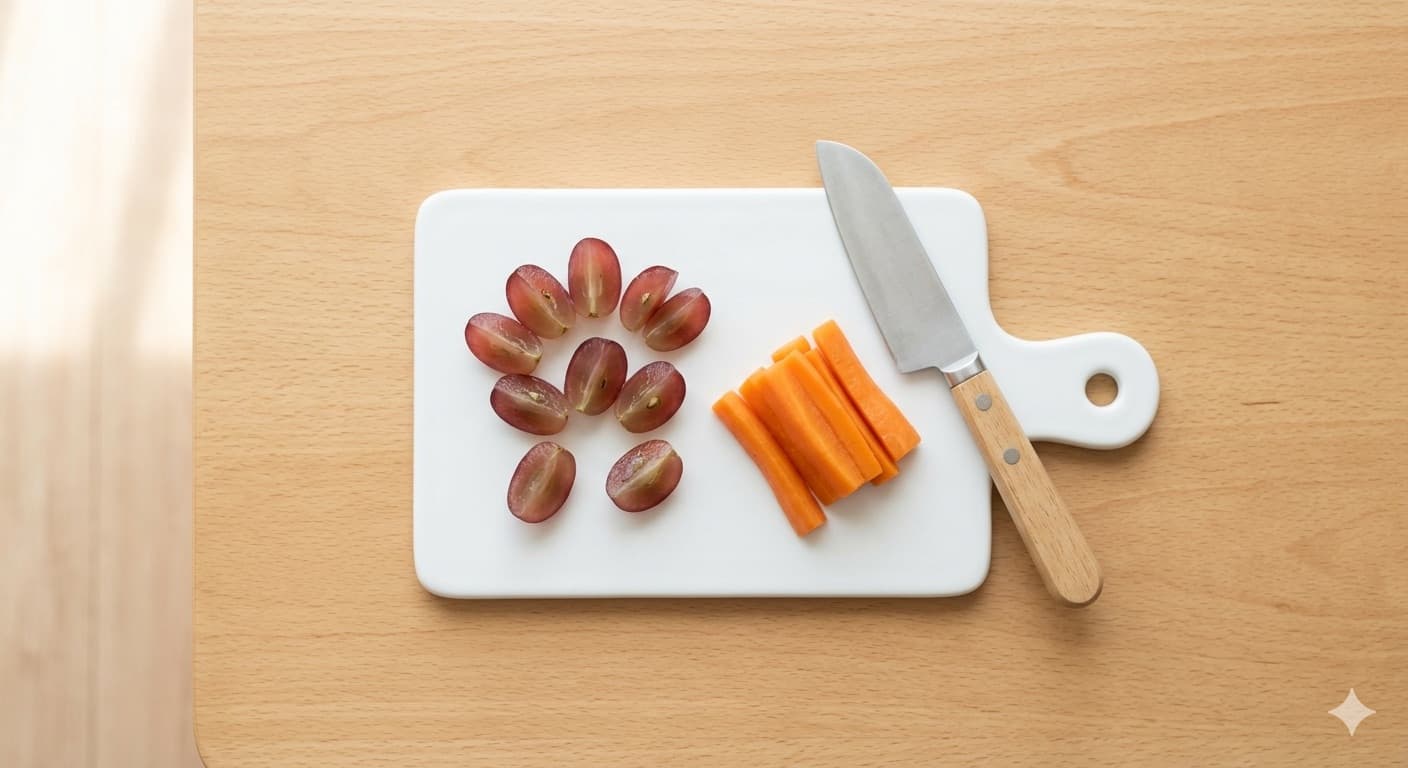
Safe: Soft-cooked udon cut into short pieces (see our Baby Udon recipe for a texture appropriate to this stage), soft rice balls (onigiri) sized for small hands, well-cooked and softened vegetables cut into baton shapes for grasping, soft fruit like banana and ripe peach
Modify:
- Grapes and cherry tomatoes - always cut into quarters, lengthwise, never just in half
- Sausages and similar shapes - cut lengthwise into strips, not into coins
- Raw vegetables - continue cooking until soft; raw carrot, celery, and similar remain a Stage 4+ or later consideration
- Natto - the sticky strands can be a minor choking concern for some babies; see our natto guide for how to manage this
Avoid: Whole nuts and seeds, popcorn, hard candy, mochi and shiratama dango, marshmallows, large chunks of meat
Stage 4 (12-18 months)
Meals increasingly resemble family food, but the foods above remain relevant - a one-year-old's airway is still small, and chewing ability, while much improved, is not yet adult-level.
Safe: Most family foods cut to appropriate size, including dishes like Oyako-ni, Baby Curry, and Kinpira Gobo prepared with manageable piece sizes
Continue to avoid or delay:
- Whole nuts (often recommended to wait until age 4-5)
- Whole grapes, cherry tomatoes, and similar round fruits unless cut
- Mochi and shiratama dango
- Hard candies and chewing gum
- Popcorn
General Safety Practices That Apply at Every Stage
- Always supervise meals. Never leave a baby alone while eating, even briefly.
- Seated and upright. Feeding should happen with the baby sitting upright, not lying back or in a moving car seat.
- Calm environment. Distractions - bouncing, walking around, laughing fits - increase risk.
- Know infant CPR and back blows/chest thrusts. A short course is genuinely worth the time for any caregiver.
- When in doubt, make it softer or smaller. There is rarely a downside to erring on the side of a more manageable piece size.
A Note From My Own Experience
Deciding to remove the shiratama dango recipe from this site was not a difficult call once I sat with it honestly. It was a recipe I liked, and shiratama is a food with real cultural warmth - the kind of thing grandparents make with children on a rainy afternoon. But "soft" shiratama is still mochi-textured, and I could not in good conscience keep a recipe like that on a baby food website, however appealing it looked in photos.
This is the kind of judgment call that comes up again and again in feeding a baby: a food can be traditional, beloved, and still not right for this particular stage of life. Recognising that distinction - without becoming anxious about every food - is, I think, one of the most useful skills a new parent can develop.
What to Read Next
- Introducing Natto to Babies: A Step-by-Step Guide
- Stage 3 Baby Food - The Japanese Approach to 9-11 Month Feeding
- When Your Baby Refuses to Eat - The Japanese Approach to Food Refusal
- How to Freeze and Batch Cook Japanese Baby Food
Yumi is a registered dietitian (管理栄養士) and certified school nutrition teacher (栄養教諭) with 7.5 years of experience planning school lunches in Japan. She is now a first-time mother navigating rinyushoku with her own daughter, applying everything she has learned - and discovering how different it is when the baby is yours.
Sources:
- Consumer Affairs Agency, Japan, annual reports on food-related choking incidents
- American Academy of Pediatrics, "Choking Prevention," Healthy Children guidelines
- Japan Pediatric Society, "Guidelines for Infant Feeding," 2022
- Ministry of Health, Labour and Welfare, Japan. Enyuushoku Shien Guide (Weaning Support Guide), 2019