
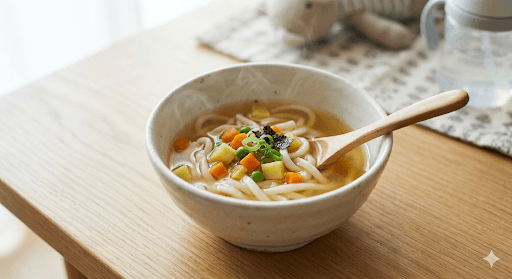
The Stage Where Meals Start to Feel Like Meals
If Stage 1 was your baby learning that food exists, and Stage 2 was your baby discovering that proteins have texture, then Stage 3 is where everything starts to feel surprisingly real.
At nine months, your baby is no longer a passive participant at the table. They are reaching for the spoon. They are picking things up off the tray. They have opinions. Loud ones.
Stage 3 - covering 9 to 11 months - is the stage I found most exciting as a dietitian and most exhausting as a mother. The food gets more complex, the portions get bigger, mealtimes shift from twice to three times a day, and your baby starts to look at you across the table like a full participant in the household rather than a small person being fed.
Here is how Japan approaches this stage, and what it means in practice.
Texture: The Soft Banana Standard
At Stage 2, the texture target was soft silken tofu. At Stage 3, the texture shifts to something with a little more body - the consistency of a ripe banana.
A ripe banana does not need teeth. You can press it against the roof of your mouth with your tongue and it yields completely. That same action - tongue pressing upward to meet the palate - is exactly what your baby is developing at this stage.
The technical term in Japanese feeding guidelines is kantan ni tsubuseru - "easily crushed." Foods should be soft enough that no teeth are required, but they no longer need to be pureed or mashed to full smoothness. Small soft pieces, coarsely mashed textures, and foods with slight resistance are all appropriate.
This matters developmentally. The chewing motions your baby practices now - even with gums, even on a soft piece of tofu - are the same motor patterns they will use with teeth later. Introducing appropriate texture at Stage 3 is not just nutritional. It supports the oral motor development that affects chewing, speech, and the ability to accept a wide range of food textures throughout childhood.
For okayu, Stage 3 means moving to a 5:1 ratio - five parts water to one part rice. The grains are now clearly visible and soft, rather than blended into a smooth paste. This porridge sits comfortably in a bowl and requires just a little gum work to eat.
Three Meals a Day: A New Rhythm
Stage 3 introduces the shift to three meals a day - and this change is more significant than it might sound.
Three meals a day means your baby is now eating at roughly the same rhythm as the rest of the family. Breakfast, lunch, dinner. In Japan, family mealtimes are deeply important, and the moment a baby begins eating three meals a day is often the moment they start joining the family table rather than being fed separately.
This is intentional. Japan's food education philosophy - shokuiku - emphasises that eating together is part of eating well. Even at nine months, a baby who sits at the family table during dinner, eating their own Stage 3 version of the family meal, is absorbing something far beyond nutrition. They are learning what mealtime looks like, what it feels like, who shares it with them.
In practice, three meals a day does require planning. Here is a structure that works well:
- Morning meal: around 7-8am, after the first breast feed or formula
- Midday meal: around 11-12pm
- Evening meal: around 5-6pm, with the family where possible
Breast milk or formula continues between meals, but the balance is shifting. By the end of Stage 3, solid food should be providing a meaningful portion of your baby's nutritional intake - particularly iron, zinc, and protein.
New Proteins at Stage 3
Stage 3 is where the protein world expands significantly. The careful introduction of Stage 2 - tofu, white fish, egg yolk, lean chicken - is now established, and we can begin adding new sources.
Whole Egg
At Stage 3, whole egg is introduced - including the white. Begin by mixing a small amount of well-cooked egg white into your baby's food alongside the yolk they already know. Egg white contains ovalbumin, one of the more common food allergens, so introduce gradually and watch carefully for any reaction.
A useful approach: start with a quarter of a whole hard-cooked egg, finely chopped or mixed into okayu or a soft vegetable dish. Increase to a half egg, then a whole egg over several weeks.
Scrambled egg cooked soft becomes a favourite Stage 3 food for many babies - and it doubles as an excellent finger food once your baby is ready to pick things up.
Other Fish
Having started with cod and sea bream in Stage 2, Stage 3 expands the range to include salmon (shake), mackerel (saba), and tuna (maguro). Salmon is particularly valuable for its omega-3 fatty acids, which support brain development. Mackerel is rich in DHA and EPA, as well as iron.
Use fresh fish where possible. Avoid smoked or salt-cured fish - the salt content is too high. Check carefully for bones at every stage.
Ground Meat
Ground beef and ground pork can be introduced at Stage 3. These are excellent sources of iron and zinc - nutrients that become increasingly important as breast milk alone can no longer meet your baby's growing needs.
Use lean ground meat. Cook it thoroughly, then mix with cooking liquid or dashi to keep it moist and soft. A small amount - 10-15g - is enough to start. The texture of finely ground meat cooked with dashi and mixed into rice porridge is one of the classic Stage 3 preparations in Japanese baby cooking.
Natto (納豆)
Natto - fermented soybeans - is a traditional Japanese food and a Stage 3 introduction that often surprises people outside Japan.
Natto is extremely nutritious. It is rich in protein, vitamin K2 (which supports bone development), and contains nattokinase, a natural enzyme. It is also naturally sticky and strong-smelling, which means Western parents sometimes hesitate.
But for babies raised in Japan, natto is simply one more food - not strange, not special, just part of the normal diet. Introducing it at Stage 3, when babies are most receptive to new textures and flavours, is the ideal window.
To serve: pull natto apart to break up the sticky strings, and mix a small amount (around one tablespoon) into okayu or soft rice. The stickiness actually helps hold the rice together in a way babies often like.
A Small Amount of Seasoning - For the First Time
Stage 3 is when Japan's guidelines first permit tiny amounts of seasoning.
Let me be clear about what "tiny" means here. We are talking about:
- A scrape of miso paste (around 0.5-1g) added to a large portion of soup or porridge
- A few drops of soy sauce (less than 1ml) used to add depth to a dish
- A small amount of katsuobushi dashi as the base liquid
This is not about making food taste salty. It is about introducing your baby to the flavours that will define Japanese cooking throughout their life - the gentle saltiness of miso, the deep umami of soy. Used in very small amounts, these seasonings round out a dish without imposing a salt load that immature kidneys cannot handle.
The guiding principle: if you taste the dish and it tastes seasoned, you have used too much. Stage 3 food should taste gentle and natural to an adult palate, with just a hint of flavour beneath the surface.
What remains off the table: strong sauces, processed seasonings, stock cubes, furikake with salt, mentsuyu (which is high in salt), and anything designed for adult taste preferences.
Finger Foods: The Grasping Stage
Around nine months, most babies develop the pincer grasp - the ability to pick up small objects between the thumb and forefinger. This is not just a motor milestone. It is an invitation.
The pincer grasp is the moment your baby can begin to feed themselves, and introducing appropriate finger foods at Stage 3 supports both the motor development and the independence that comes with it.
Good Stage 3 finger foods include:
- Soft boiled carrot sticks - cut into small pieces your baby can grip and gum
- Soft tofu cubes - small enough to pick up, soft enough to dissolve
- Well-cooked pasta - short shapes, slightly overcooked so they yield under gum pressure
- Soft bread (low-salt where possible) - torn into small pieces
- Banana pieces - the natural texture standard for Stage 3 is also a perfect finger food
- Soft scrambled egg - spooned in small mounds onto the tray
- Boiled potato pieces - soft, starchy, easy to gum
The key is size and softness. Pieces should be small enough that a baby who puts the whole thing in their mouth will not choke - roughly 1cm cubes as a starting guide - and soft enough to dissolve without teeth.
Expect mess. Embrace mess. The sensory experience of picking up food, feeling its texture, sometimes squishing it before eating it, is part of how babies learn about food. In my experience, the babies who are allowed to be messy at Stage 3 are often the more adventurous eaters at Stage 4.
Portion Sizes at Stage 3
Here is a general guide to amounts per meal at Stage 3. By the end of Stage 3 (around 11 months), you should be approaching the higher end of these ranges.
| Food group | Amount per meal |
|---|---|
| Okayu (5:1) or soft rice | 90g |
| Vegetables | 30-40g |
| Protein (tofu) | 45g |
| Protein (fish) | 15g |
| Protein (meat) | 15g |
| Protein (egg) | up to 1 whole egg |
| Natto | 10-15g |
These amounts are per meal, across three meals a day. Breast milk or formula continues, but solid food is now nutritionally significant.
A Sample Day at Stage 3
Here is what a typical day might look like for a ten-month-old well established at Stage 3:
Morning (around 7:30am)
- 5:1 okayu: 90g, with a tiny scrape of miso stirred through
- Mashed pumpkin and onion with dashi: 30g
- Scrambled egg: half a well-cooked egg, mixed in
- Breast milk or formula after
Midday (around 11:30am)
- Soft rice with minced salmon and dashi: 90g total
- Soft boiled broccoli florets (finger food): 20g
- Soft tofu cubes (finger food): 30g
- Breast milk or formula after
Evening (around 5:30pm)
- Soft rice porridge with finely ground beef and carrot: 90g
- Mashed potato with a little dashi: 30g
- A few pieces of soft banana (finger food)
- Breast milk or formula after
A Note From My Own Experience
Around nine months, my daughter discovered she could pick things up.
The first time she successfully got a piece of soft tofu from the tray to her mouth, she looked at me with an expression I can only describe as triumph. She knew she had done something. She was not just being fed - she was eating.
That shift - from passive to active - happens at Stage 3, and it is profound. But I will be honest: it is also when mealtimes got considerably messier and considerably longer. She wanted to handle everything. She wanted to decide what went in her mouth and in what order. She dropped things on purpose to see what happened.
I had to remind myself - constantly - that this was not misbehaviour. This was learning. Every dropped piece of tofu was sensory information. Every handful of okayu squeezed between her fingers was texture exploration. My professional training told me this was developmentally appropriate. My floor told me something else.
One thing that helped: I stopped trying to keep mealtimes clean and started thinking of them as messy by design. I put a splash mat under the high chair. I gave her a pre-loaded spoon to hold while I fed her with another. I let her pick up finger foods while I offered the okayu on a spoon. She ate more when she felt in control of some part of the meal.
That small shift made Stage 3 something I genuinely enjoyed - mess and all.
What to Read Next
- Stage 4 Baby Food - The Japanese Approach to 12-18 Month Feeding
- Stage 2 Baby Food - The Japanese Approach to 7-8 Month Feeding
- Baby Dashi Guide - Every Type of Japanese Stock for Weaning, by Stage
- What Is Shokuiku? Japan's Food Education Philosophy Explained
Yumi is a registered dietitian (管理栄養士) and certified school nutrition teacher (栄養教諭) with 7.5 years of experience planning school lunches in Japan. She is now a first-time mother navigating rinyushoku with her own daughter - currently in the thick of Stage 3, with okayu on the walls to prove it.
Sources:
- Ministry of Health, Labour and Welfare, Japan. Enyuushoku Shien Guide (Weaning Support Guide), 2019
- Japan Pediatric Society, "Guidelines for Infant Feeding," 2022
- Coulthard H et al., "Delayed introduction of lumpy foods to children during the complementary feeding period affects child's food acceptance and feeding at 7 years of age," Maternal and Child Nutrition, 2009
- Fewtrell M et al., "Complementary Feeding: A Position Paper by the European Society for Paediatric Gastroenterology, Hepatology, and Nutrition," JPGN, 2017
- Deoni SCL et al., "Breastfeeding and early white matter development," Neuroimage, 2013