
Something Shifts Around Seven Months
You will notice it. One day around six or seven months, your baby will look at the smooth okayu you have been carefully preparing, and you will sense they are ready for something more. They might grab at the spoon with more intention. They might seem slightly bored. They might be finishing every last drop and looking at you for more.
This is Stage 2 of rinyushoku, and it is one of my favourite stages - both professionally and as a mother. The cautious, one-spoon-at-a-time work of Stage 1 has laid the foundation. Now, for the first time, your baby's meals start to feel like real food.
Here is everything you need to know about feeding your 7-8 month old the Japanese way.
What Changes at Stage 2
The single most important change at Stage 2 is texture.
In Stage 1, food was smooth enough to pour - almost liquid. The goal was simply for your baby to understand that a spoon brings something into their mouth, and that swallowing is possible.
At Stage 2, we move to the consistency of soft tofu - that silken tofu texture that holds together but yields completely under the gentlest pressure. Think of pressing a piece of silken tofu between two fingers: it offers just a little resistance before it gives. That is exactly the texture your baby's gums - which are surprisingly strong - can now handle.
This is a meaningful shift. Your baby is no longer just swallowing. They are beginning to learn the earliest stage of what will eventually become chewing.
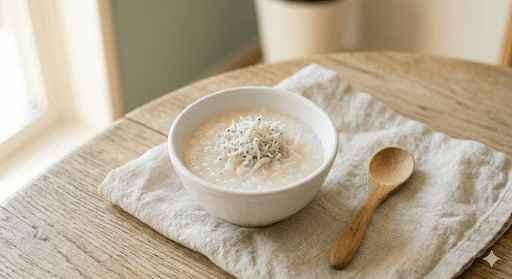
For okayu (rice porridge), Stage 2 means moving from the 10:1 ratio of Stage 1 to a 7:1 ratio - slightly less water, slightly more body. The grains begin to hold their shape, though they are still very soft.
Meal Frequency: Two Meals a Day
At Stage 2, Japan's guidelines recommend moving from one meal a day to two meals a day - ideally at consistent times, such as mid-morning and late afternoon.
Breast milk or formula remains the primary source of nutrition. Solid food at this stage is still practice, still exploration - but with two meals a day, your baby begins to develop a rhythm around eating that will serve them well in Stage 3 and beyond.
A practical approach is to establish mealtimes around your family's own routine. In Japan, meal culture is built around regularity. Even at seven months, beginning to connect food with particular times of day is considered part of shokuiku - food education - from the very start.
New Foods at Stage 2: Expanding the World
Stage 1 was vegetables and okayu. Stage 2 is where the world opens up. This is when we introduce proteins for the first time, and when the range of vegetables expands considerably.
Proteins: The Careful Introduction
Tofu (豆腐) Tofu is typically the first protein Japanese babies receive. It is gentle on the digestive system, low in allergen risk compared to other proteins, easy to prepare, and its texture is already close to the Stage 2 consistency target. Start with silken tofu (kinu tofu), boiled briefly and mashed smooth. A small amount - around 10-15g - is appropriate to start.
White fish: cod (タラ) and sea bream (鯛) White fish is the second protein introduced. In Japan, sea bream (tai) holds cultural significance - it appears at celebrations and omedetai ("auspicious") occasions, and giving a baby their first taste of tai is considered a small joy. Cod is equally gentle. Boil a small piece without any seasoning, check carefully for bones, and mash with a little dashi or cooking liquid until smooth.
Start with around 10g of fish. Watch for any reaction over two to three days before introducing a new food.
Egg yolk Egg yolk is introduced in Stage 2 - but only the yolk, never the white. Egg white contains proteins that are more allergenic and are not recommended until Stage 3 or later. Begin with a very small amount of hard-cooked egg yolk - the tip of a teaspoon - mashed smooth and mixed into okayu. Increase gradually to a full yolk over several weeks.
Chicken (chicken breast or tender) Chicken is introduced toward the middle or end of Stage 2. Use the leanest part - chicken breast or tender (sasami) - as it is lowest in fat and easiest to digest. Boil without seasoning, then mince very finely or blend with a little cooking liquid to reach the right texture. Around 10-15g is the typical starting amount.
Vegetables: Expanding the Range
By Stage 2, your baby should already be familiar with a few vegetables from Stage 1. Now you can introduce:
- Broccoli - steam until very soft, mash well, remove any tough stems
- Cauliflower - mild and easy to purée
- Green beans - remove the fibrous string, cook until soft
- Corn - pass through a sieve to remove the skins, which are too tough
- Potato - boiled and mashed; a soft, neutral base that works well with dashi
- Onion - cooked until completely soft and sweet; adds natural flavour
- Tomato - remove the skin and seeds; the flesh is gentle and slightly acidic in a way babies often enjoy
The principle remains the same as Stage 1: introduce new foods one at a time, two to three days apart, so you can identify any reactions.
Introducing Dashi: Japan's Natural Flavour Enhancer
If there is one thing that sets Japanese baby food apart from other approaches, it is the early introduction of dashi.
Dashi is Japanese stock - typically made from kombu (kelp) and katsuobushi (dried bonito flakes). It contains naturally occurring glutamate and inosinic acid, the compounds responsible for umami - the fifth taste, the savoury depth that makes food satisfying and complete.
Plain boiled vegetables can taste flat to a baby who is encountering them for the first time. A small amount of unsalted dashi added to mashed vegetables, okayu, or a simple soup transforms the dish without adding any salt, sugar, or artificial flavouring. It simply makes the food taste more like food.
Japan's official weaning guidelines support the introduction of dashi at Stage 2. The key is using the right kind:
Kombu dashi (昆布だし): Made by soaking a small piece of dried kombu in cold water for several hours, or by gently heating it to around 60-65°C. This is the gentlest dashi, with a clean, subtle umami. It is ideal for younger Stage 2 babies.
Kombu + katsuobushi dashi: A fuller-flavoured stock, introduced once your baby is comfortable with kombu dashi. Bring kombu dashi to just below a boil, add a small handful of katsuobushi, steep for a few minutes, then strain. No salt.
For a full guide to making and using dashi at each stage, see the Baby Dashi Guide.
What Not to Add: Salt and Sugar Still Avoided
At Stage 2, salt and sugar remain off the table.
This is not overly cautious. It is physiologically appropriate. A baby's kidneys at seven to eight months are still developing and cannot efficiently process the sodium load that even small amounts of added salt would impose. The Japanese guidelines recommend zero added salt until the transition toward Stage 4, and only tiny amounts even then.
More importantly, avoiding salt and sugar at this stage preserves your baby's sensitivity to natural flavours. A baby who has been fed unseasoned food for their first several months of eating will find the natural sweetness of kabocha genuinely satisfying. They will notice the umami in dashi. They will be curious about the mild bitterness of spinach. This is the foundation of a varied, adventurous palate - and it is built right now.
Portion Sizes at Stage 2
Here is a general guide to amounts at Stage 2. These are starting points - follow your baby's lead.
| Food group | Amount per meal (later Stage 2) |
|---|---|
| Okayu (7:1) | 50-80g |
| Vegetables | 20-30g |
| Protein (tofu) | 30-40g |
| Protein (fish) | 10-15g |
| Protein (chicken) | 10-15g |
| Egg yolk | Up to 1 yolk |
Start at the lower end and increase gradually. These amounts are per meal, across two meals a day. Breast milk or formula continues at all other feeds.
A Sample Day at Stage 2
Here is what a typical day might look like for an eight-month-old baby well established at Stage 2:
Morning (around 10am)
- 7:1 okayu: 60g, mixed with a small amount of kombu dashi
- Mashed kabocha and potato: 25g total, cooked with a little dashi
- Mashed tofu: 30g, boiled and cooled
- Breast milk or formula after the meal
Afternoon (around 3pm)
- 7:1 okayu: 60g
- Mashed broccoli with a little dashi: 20g
- Minced chicken with cooking liquid: 10g
- Breast milk or formula after the meal
All other feeds: Breast milk or formula as usual
This menu looks simple, and it is meant to. The goal at Stage 2 is not complexity. It is variety, consistency, and allowing your baby to experience each new flavour clearly.
A Note From My Own Experience
My daughter reached Stage 2 at around seven months. I remember the moment I first gave her a piece of mashed silken tofu mixed into her okayu - I watched her face very carefully, the professional in me assessing her swallowing pattern, the mother in me just hoping she would like it.
She paused. She worked her gums. She swallowed.
And then she opened her mouth for more.
What moved me was not just that she liked it. It was that she was learning to trust food - to approach a new texture without panic, to process it, to decide. After weeks of smooth porridge, a baby discovering that food can have gentle texture is experiencing something genuinely new about the world.
I also noticed, around this stage, that mealtimes started to feel like events. She would see her biogetti bowl (we used a soft silicone bowl with a suction base - lifesaving) and straighten up in her high chair. She was beginning to understand that this was a moment, a ritual, something that happened regularly and that ended in satisfaction.
That is Stage 2. Small textures, small amounts, enormous learning.
What to Read Next
- Stage 3 Baby Food - The Japanese Approach to 9-11 Month Feeding
- Baby Dashi Guide - Every Type of Japanese Stock for Weaning, by Stage
- 10:1 Okayu - Japanese Rice Porridge for Babies (Stage 1)
- When to Start Solids - The Japanese Approach to Beginning Baby Food
Yumi is a registered dietitian (管理栄養士) and certified school nutrition teacher (栄養教諭) with 7.5 years of experience planning school lunches in Japan. She is now a first-time mother navigating rinyushoku with her own daughter, applying everything she has learned - and discovering how different it is when the baby is yours.
Sources:
- Ministry of Health, Labour and Welfare, Japan. Enyuushoku Shien Guide (Weaning Support Guide), 2019
- Japan Pediatric Society, "Guidelines for Infant Feeding," 2022
- Mennella JA et al., "Flavor Programming During Infancy," Chemical Senses, 2014
- Coulthard H et al., "Delayed introduction of lumpy foods to children during the complementary feeding period," Maternal and Child Nutrition, 2009