
Why Constipation Is So Common After Starting Solids
If your baby has become noticeably more uncomfortable, straining, or going several days without a bowel movement since starting solids, you are not imagining it - and you are far from alone.
Before weaning, a breastfed or formula-fed baby's diet is entirely liquid. The moment solid food enters the picture, the digestive system suddenly has to process fibre, denser textures, and a much wider range of foods. It is one of the biggest adjustments a baby's gut makes in its first year, and a temporary slowdown is extremely common.
The good news is that Japanese weaning foods, many of which are naturally high in fibre and gentle on digestion, are well suited to easing this transition - often without needing anything beyond what is already in a typical rinyushoku rotation.
What Counts as Constipation in a Baby
Bowel habits vary enormously between babies, and frequency alone is not the best indicator. Signs worth paying attention to include:
- Hard, pellet-like, or dry stools
- Visible straining, discomfort, or crying during bowel movements
- A noticeably swollen or hard abdomen
- A baby who seems to be "holding it in" - going stiff or arching their back
A baby who goes every other day but passes a soft stool without distress is usually fine. A baby who goes daily but produces something hard and uncomfortable may still be constipated.
Gentle, High-Fibre Foods From the Japanese Pantry
Satsumaimo (Japanese sweet potato)
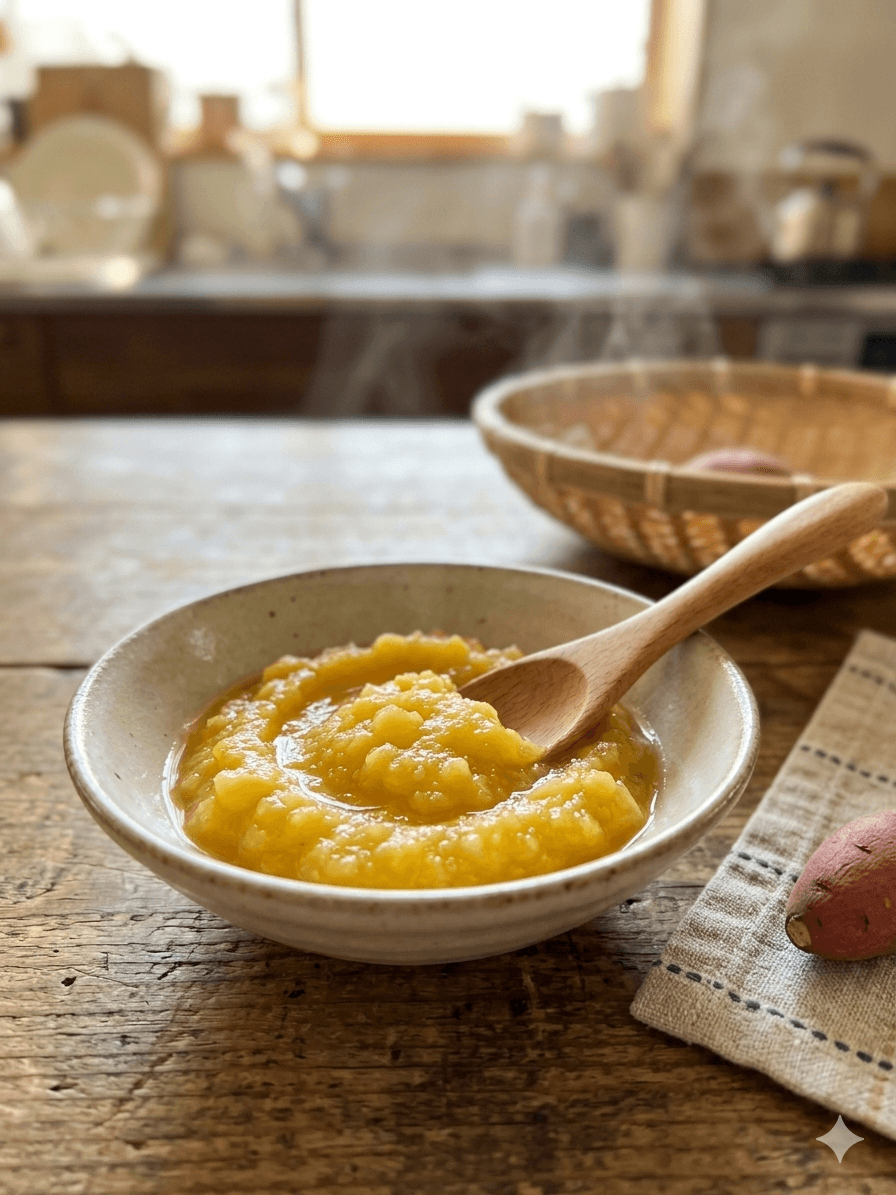
Satsumaimo is one of the most useful foods for this exact situation. It is naturally sweet (so babies tend to accept it readily), high in fibre, and gentle enough to introduce from Stage 1. Steam or bake until very soft, then mash - the skin can be left on for older babies in Stage 3 and beyond, adding even more fibre.
Our Sweet Potato and Apple Dashi Simmer combines satsumaimo with apple, another fibre source, for a dish that does double duty as a constipation remedy and a genuinely well-loved meal.
Kabocha (Japanese pumpkin)
Like satsumaimo, kabocha is naturally sweet, fibre-rich, and easy to digest. Steamed and mashed, it is a Stage 1-friendly food that many babies enjoy and that supports regular digestion.
Natto
Fermented soybeans bring both fibre and beneficial bacteria (probiotics) from the fermentation process. For babies who can manage the texture - typically Stage 3 onward - natto can have a noticeably positive effect on regularity. See our guide on introducing natto to babies.
Prune-like fruits: apple, pear, and ripe banana
While not uniquely Japanese, these fruits are commonly used in Japanese households as gentle, naturally sweet sources of fibre and sorbitol, a sugar alcohol that has a mild softening effect on stool. A small amount of stewed apple or very ripe, mashed banana is often enough.
Miso soup (in moderation, from Stage 2)
A small amount of mild miso soup, made with dashi and soft vegetables, brings fermented food benefits along with hydration. See our Miso Soup for Babies recipe for a low-sodium version.
Hydration Matters as Much as Fibre
A common cause of constipation after starting solids is simply that total fluid intake drops. Before weaning, 100% of a baby's intake is liquid. Once solids are introduced, that ratio shifts - and if breast milk or formula intake decreases too quickly, overall hydration can fall even as fibre intake rises, which can actually make constipation worse.
Dashi-based soups and simmered dishes are useful here because they deliver both nutrients and fluid in the same spoonful. For babies in Stage 2 and beyond, small amounts of water offered with meals (see our guide on what babies can drink, by stage) can also help.
What to Avoid Making Worse
A few common weaning staples, while not problems on their own, can contribute to constipation if they make up too much of the diet:
- Too much rice/okayu relative to vegetables - okayu is low in fibre compared to vegetables and fruit
- Banana before it is fully ripe - underripe banana is more binding than ripe banana
- Too little variety - relying on the same two or three foods reduces the range of fibre types your baby gets
The goal is not to remove these foods, but to make sure they are balanced with the fibre-rich options above.
A Simple Constipation-Friendly Day (Stage 2-3)
| Meal | Foods |
|---|---|
| Morning | Okayu with mashed kabocha and a little kombu dashi |
| Afternoon | Satsumaimo and apple simmer, soft tofu |
| Optional snack | Mashed ripe banana or stewed pear |
If symptoms persist for more than a week, or if you notice blood in the stool, significant pain, or a baby who seems unwell beyond the constipation itself, it is important to consult your pediatrician rather than relying on dietary changes alone.
A Note From My Own Experience
My daughter went through a brief constipated stretch right after we increased her okayu thickness from 10:1 to 7:1 - the denser texture seemed to catch her digestion off guard for a few days. What helped was not panicking, but simply leaning harder into kabocha and satsumaimo for a few days, alongside a little extra water after meals.
It resolved within about three days, and I learned something I now tell other parents often: a temporary slowdown after a change in texture or routine is usually just an adjustment, not a problem to solve aggressively. Gentle, fibre-rich, familiar foods - given time - are often all that is needed.
What to Read Next
- Sweet Potato and Apple Dashi Simmer recipe
- Introducing Natto to Babies: A Step-by-Step Guide
- What Can Babies Drink? Water, Mugicha, and Dashi by Stage
- How to Freeze and Batch Cook Japanese Baby Food
Yumi is a registered dietitian (管理栄養士) and certified school nutrition teacher (栄養教諭) with 7.5 years of experience planning school lunches in Japan. She is now a first-time mother navigating rinyushoku with her own daughter, applying everything she has learned - and discovering how different it is when the baby is yours.
Sources:
- Ministry of Health, Labour and Welfare, Japan. Enyuushoku Shien Guide (Weaning Support Guide), 2019
- Japan Pediatric Society, "Guidelines for Infant Feeding," 2022
- Tabbers MM et al., "Evaluation and treatment of functional constipation in infants and children," Journal of Pediatric Gastroenterology and Nutrition, 2014
- Lever E et al., "Systematic review: the effect of prunes on gastrointestinal function," Alimentary Pharmacology & Therapeutics, 2014