
Why Iron Becomes Urgent Around Six Months
Babies are born with iron stores built up during pregnancy, and for the first several months those stores quietly cover their needs. But by around six months, those reserves begin to run low - right around the same time most babies start solid food.
This is not a coincidence. It is one of the main reasons weaning begins when it does. Breast milk is wonderful for many things, but it is low in iron, and formula-fed babies generally have more of a buffer than breastfed babies. Either way, from six months onward, food becomes the primary source of iron - and iron is essential for brain development that is happening at a rapid pace during this exact window.
Low iron in infancy has been linked to effects on cognitive and motor development that can be difficult to fully reverse later. The good news is that Japanese cuisine, often associated with light, vegetable-forward dishes, actually has a strong lineup of iron-rich foods once you know where to look.
The Two Types of Iron
There are two forms of dietary iron, and they behave differently in the body:
Heme iron comes from animal sources - meat, fish, and poultry. It is absorbed efficiently, often in the range of 15-35%, regardless of what else is eaten alongside it.
Non-heme iron comes from plant sources - tofu, leafy greens, legumes like natto. It is absorbed far less efficiently on its own, often under 10%, but absorption can be significantly boosted when paired with vitamin C or with heme iron in the same meal.
A Japanese weaning diet that includes both types, eaten together, gives a baby the best of both worlds.
Iron-Rich Japanese Foods by Stage
Stage 2 (7-8 months)
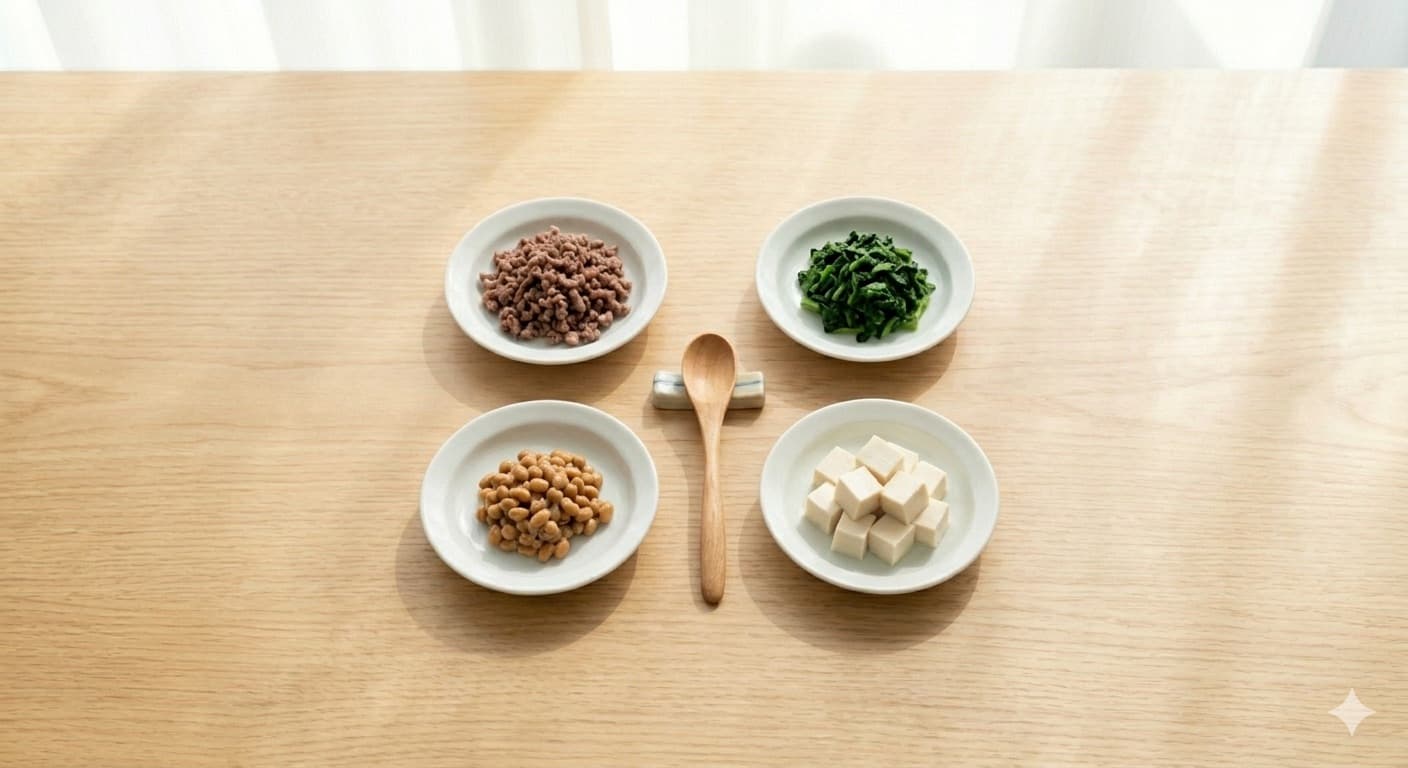
Red meat (lean beef or liver) Introduced gently from the middle of Stage 2, finely minced lean beef or a small amount of well-cooked chicken liver are among the richest iron sources available. Liver in particular is concentrated - even a teaspoon-sized portion, a few times a week, makes a meaningful difference. Simmer until very soft, then mince finely or blend with a little dashi.
Sardines and other small oily fish (shirasu, iwashi) Shirasu (boiled baby sardines) is a Japanese weaning staple and a good source of iron as well as calcium. Rinse well to reduce salt, then mix into okayu.
Tofu and edamame Both are useful non-heme sources, especially when combined with vitamin C-rich vegetables in the same bowl.
Stage 3 (9-11 months)
Oyako-don style dishes (chicken and egg over rice) A simple oyako-ni (chicken and egg simmered together) delivers iron from both the chicken and the egg yolk, in a texture babies at this stage handle well. See our Oyako-ni recipe for a baby-friendly version.
Natto Fermented soybeans are a notable source of iron and also bring vitamin K2 and probiotics. See our full guide on introducing natto to babies for how to manage the texture safely.
Spinach and komatsuna (Japanese mustard spinach) Dark leafy greens are iron-rich on a non-heme basis. Blanch thoroughly, chop finely, and pair with a protein or a squeeze of something acidic.
Stage 4 (12-18 months)
Gyudon-style beef and rice A toddler portion of simmered beef with onion over soft rice is one of the most efficient iron-dense meals in Japanese home cooking. See our Baby Gyudon recipe for a low-sodium version appropriate for this stage.
Sanma (Pacific saury) and other oily fish Rich in iron as well as omega-3s. Our Sanma no Tsumire-ni (fish meatball simmer) recipe is a gentle way to introduce it.
Boosting Absorption: Pair Iron With Vitamin C
Because non-heme iron is absorbed poorly on its own, the single most useful trick in a Japanese weaning kitchen is to serve iron-rich foods alongside something containing vitamin C.
Good Japanese vitamin C sources for babies include:
- Satsumaimo (sweet potato) - mildly sweet and gentle on digestion
- Kabocha squash - subtly sweet, easy to mash
- Broccoli - steamed until very soft
- Citrus - a small amount of mikan (mandarin) from Stage 3 onward
- Tomato - skin and seeds removed
A practical example: a bowl of okayu with finely minced beef, mashed kabocha, and a little spinach is not just a balanced-looking meal - it is specifically designed, from an absorption standpoint, to help your baby actually use the iron in that beef.
What to Watch For
Iron deficiency in infants can be subtle. Signs to discuss with your pediatrician include:
- Pale skin, especially around the lips, gums, and inner eyelids
- Unusual tiredness or reduced interest in surroundings
- Slower-than-expected weight gain
- Frequent infections
If your baby was born prematurely, was low birth weight, or is exclusively breastfed past six months without much iron-rich food yet, it is worth raising the topic with your pediatrician proactively. The American Academy of Pediatrics recommends iron supplementation of 1 mg/kg/day starting around four months for exclusively breastfed infants, continued until iron-rich foods are well established - a recommendation worth discussing at your next checkup if it applies to your baby.
A Sample Iron-Focused Meal (Stage 3)
| Component | Amount | Iron role |
|---|---|---|
| 7:1 to 5:1 okayu | 80g | Base |
| Finely minced beef, simmered | 15g | Heme iron |
| Mashed kabocha | 20g | Vitamin C, pairs with beef |
| Spinach, finely chopped | 10g | Non-heme iron |
| Dashi | A few spoonfuls | Flavour, encourages eating the whole portion |
A Note From My Own Experience
When my daughter reached Stage 2, iron was the first nutrient I found myself actively thinking about as a dietitian rather than just as a mother. It is easy to focus on textures and allergens and forget that, quietly, a baby's iron stores are dropping in the background.
What helped me was not a complicated supplement routine, but simply making sure that most days included something from the iron list above, paired with something from the vitamin C list. It did not need to be the same meal every day, and it did not need to be perfect. Over a week, it balances out.
What to Read Next
- Stage 2 Baby Food - The Japanese Approach to 7-8 Month Feeding
- Stage 3 Baby Food - The Japanese Approach to 9-11 Month Feeding
- Introducing Natto to Babies: A Step-by-Step Guide
- Baby Dashi Guide - Every Type of Japanese Stock for Weaning, by Stage
Yumi is a registered dietitian (管理栄養士) and certified school nutrition teacher (栄養教諭) with 7.5 years of experience planning school lunches in Japan. She is now a first-time mother navigating rinyushoku with her own daughter, applying everything she has learned - and discovering how different it is when the baby is yours.
Sources:
- Ministry of Health, Labour and Welfare, Japan. Enyuushoku Shien Guide (Weaning Support Guide), 2019
- World Health Organization, "Iron Deficiency Anaemia: Assessment, Prevention, and Control," 2001
- Domellof M et al., "Iron requirements of infants and toddlers," Journal of Pediatric Gastroenterology and Nutrition, 2014
- Lonnerdal B, "Excess iron intake as a factor in growth, infections, and development of infants and young children," American Journal of Clinical Nutrition, 2017
- American Academy of Pediatrics, Committee on Nutrition, "Diagnosis and Prevention of Iron Deficiency and Iron-Deficiency Anemia in Infants and Young Children," Pediatrics, 2010