
A Meal a Baby Cannot Yet Eat
One of the most touching traditions in Japanese family life is okuizome - literally "first eating" - a ceremony held around a baby's hundredth day of life. A full, beautiful meal is prepared and brought to the baby's lips, even though the baby, at around three months, cannot actually eat any of it.
That is rather the point. Okuizome is a ritual of hope: a wish, expressed through food, that this child may go through their whole life never wanting for a meal.
The Meaning and History
Okuizome dates back over a thousand years, to the Heian period. It is held on the 100th day after birth - though many families choose the 110th or 120th day, and there is no need to be rigid about the exact date. Historically, reaching one hundred days was itself a milestone in a baby's survival, and the ceremony grew from gratitude and a prayer for continued health.
The phrase often attached to it is the wish that the child will "never be troubled by hunger for a lifetime" (一生食べ物に困らないように). It is a quiet, food-centred expression of a parent's deepest hope.
The Traditional Meal: Ichiju Sansai
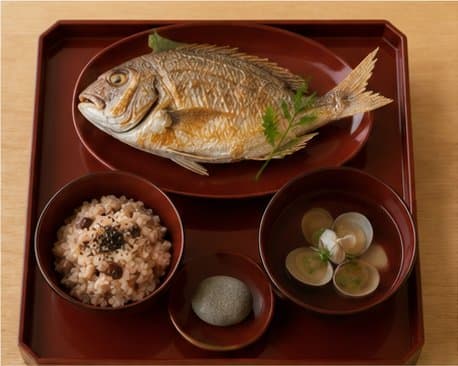
The okuizome meal follows the classic Japanese structure of ichiju sansai - one soup and three dishes - scaled up into a celebratory feast. A typical spread includes:
- Grilled whole sea bream (tai): Served head and tail intact (okashira-tsuki), symbolising completeness from beginning to end. Tai is the celebratory fish of Japan, its name echoing "medetai" (auspicious).
- Sekihan (red rice): Rice steamed with azuki beans, giving it a festive reddish colour. Red has long been considered auspicious and protective.
- Suimono (clear soup): Often with clam, whose paired shell symbolises a good future partnership.
- Nimono (simmered vegetables): Seasonal vegetables, often cut into auspicious shapes.
- Kounomono (pickles): And sometimes umeboshi, expressing a wish for a long, wrinkled-to-old-age life.
The colours and choices vary by region and household - the symbolism matters more than exact uniformity.
The Tooth-Hardening Stone (Hagatame-no-Ishi)
A distinctive part of okuizome is the hagatame-no-ishi, the "tooth-hardening stone." A small clean pebble - traditionally borrowed from the grounds of a shrine, then returned afterwards - is placed on the tray. During the ceremony, the chopstick tips are touched gently to the stone and then lightly to the baby's gums or lips.
This expresses the wish for strong, healthy teeth - and, by extension, a strong body. The baby of course never touches the stone itself; it is purely symbolic.
How the Ceremony Is Performed
The "feeding" is done by the oldest person present of the same sex as the baby - traditionally a grandparent - reflecting a wish to pass on long life. They take the food in a particular order, bringing each item to the baby's lips in turn without actually feeding:
A common sequence is repeated three times: rice → soup → rice → fish → rice → soup, and then the tooth-hardening stone. The exact order varies by family and region; what matters is the gesture and the intention behind it.
Holding One at Home Today
Modern families hold okuizome in all sorts of ways. Some cook the full traditional spread, some order a prepared okuizome set, and some simplify it to the essentials with a small tai and a bowl of sekihan. Restaurants and photo studios offer packages too. There is no single correct way.
If you would like to mark it simply at home, a grilled tai, a little sekihan, a clear soup, and a clean pebble are more than enough to carry the meaning. It is a lovely occasion to gather close family and take a photograph you will treasure.
A gentle note: this is a symbolic ceremony, not real feeding. A three-month-old is not yet ready for solids - actual weaning begins later, around five to six months. See our guide on when to start solids for that next chapter.
A Note From My Own Experience
We held my daughter's okuizome at home on her 110th day, because the hundredth fell on a chaotic week and I decided, as the ceremony itself teaches, not to be rigid about it. My mother performed the feeding gestures, her hands a little unsteady with emotion, touching the chopsticks to a pebble we had picked up at our local shrine that morning.
My daughter mostly tried to grab the chopsticks and looked deeply unimpressed by the sea bream. But the meaning was never for her, not really - it was for us, the adults around the table, making a wish over a child we loved more than we knew how to say. That, I think, is what food rituals are for.
What to Read Next
- Ichiju Sansai: The Japanese Meal Formula That Makes Nutrition Simple
- When to Start Solids - The Japanese Approach to Beginning Baby Food
- Washoku and Seasonality: How Japan's Food Culture Follows the Harvest
- What Is Shokuiku? Japan's Food Education Philosophy Explained
Yumi is a registered dietitian (管理栄養士) and certified school nutrition teacher (栄養教諭) with 7.5 years of experience planning school lunches in Japan. She is now a first-time mother navigating rinyushoku with her own daughter, applying everything she has learned - and discovering how different it is when the baby is yours.
Sources:
- Government of Japan, "Whole Sea Bream: An Indispensable Food in Japan's Traditional Okuizome Ceremony," Highlighting Japan, 2023
- Japanese cultural and folklore references on okuizome (お食い初め) custom and history