
The Question Every Parent Asks
"Is my baby eating enough?" is, in my experience, the single most common worry of the weaning months - closely followed by its opposite, "Is my baby eating too much?"
The reassuring truth is that during the first year, solid food is not yet about meeting your baby's full nutritional needs. Breast milk or formula remains the foundation. Solids are practice, exploration, and a gradually growing contribution - not a replacement. Understanding this balance takes a great deal of pressure off the spoon.
Here is how much food babies typically need at each stage of rinyushoku, and how the milk-to-solids balance shifts over time.
Stage 1 (5-6 months): Milk Is Almost Everything
At Stage 1, solid food is a brand new skill, not a source of calories. Your baby is learning to move food from the front of the mouth to the back and swallow - a genuinely new movement.
- Solids: One meal a day, starting with a single teaspoon and building slowly
- Milk: Breast milk or formula on demand, exactly as before - no reduction
If your baby eats one spoon and turns away, that is completely normal and not a problem. The goal is the experience, not the volume.
Stage 2 (7-8 months): Two Meals, Milk Still Leading
By Stage 2, your baby is eating with more intention, and the range of foods expands to include proteins. Solids begin to matter nutritionally - this is the stage where iron-rich foods become genuinely important - but milk is still the larger part of the diet.
A rough guide per meal, across two meals a day:
| Food group | Amount per meal |
|---|---|
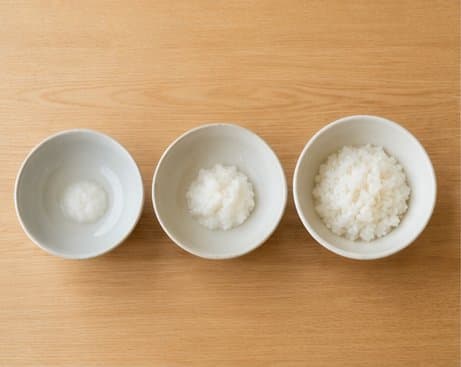
| Okayu (7:1) | 50-80g |
| Vegetables | 20-30g |
| Protein (tofu) | 30-40g, or fish/chicken 10-15g |
Milk continues after meals and at other feeds. See our Stage 2 guide and iron-rich foods guide for more.
Stage 3 (9-11 months): Three Meals, Balance Tipping
This is the stage where solids start to carry real nutritional weight. Babies typically move to three meals a day, and food now provides a meaningful share of energy and nutrients - the World Health Organization notes that from around this age, complementary foods supply an increasing proportion of a baby's needs.
A rough guide per meal:
| Food group | Amount per meal |
|---|---|
| Soft rice (5:1) | 80-90g |
| Vegetables | 30-40g |
| Protein (fish/meat) | 15g, or tofu 45g, or one egg yolk-to-whole |
Milk feeds usually reduce naturally as meals grow, but breast milk or formula still typically provides a large share of nutrition at this stage.
Stage 4 (12-18 months): Solids Take the Lead
By Stage 4, the relationship flips. Three meals a day plus one or two small snacks become the main source of nutrition, and milk shifts to a supporting role.
- Solids: Three meals plus 1-2 snacks; portions approaching a small version of family food
- Milk: Breast milk as desired, or around 300-400ml of formula or cow's milk (cow's milk as a main drink from 12 months) - more a complement than a core source now
The Most Important Principle: Follow the Baby
Every chart above is a starting point, not a target to hit. Babies self-regulate energy intake remarkably well when allowed to - they eat more on some days and less on others, and appetite varies with growth spurts, teething, and activity.
The Japanese principle of hara hachi bu - eating to satisfaction rather than to a fixed amount - applies even to babies. A responsive approach means offering appropriate food and letting your baby decide how much to eat. Signs of fullness - turning away, closing the mouth, losing interest - are worth respecting rather than overriding.
If your baby is growing steadily along their own curve, has regular wet nappies, and is generally content, they are almost certainly eating enough - regardless of whether they finished what was on the spoon.
When to Check With a Professional
Talk to your pediatrician or a dietitian if you notice:
- Weight gain that has clearly flattened or dropped across the growth chart
- Consistent refusal of nearly all solids well into Stage 3
- Signs of dehydration, lethargy, or far fewer wet nappies
- Ongoing worry that is affecting how mealtimes feel
Most feeding worries resolve with reassurance and time, but persistent concerns are always worth a professional conversation.
A Note From My Own Experience
I am a dietitian, and I still caught myself measuring my daughter's okayu by the gram in the early weeks, quietly anxious when she left half of it. What changed my perspective was watching her over a whole week rather than a single meal. Some days she was ravenous, other days barely interested - and across the week, it balanced beautifully, and she grew exactly as she should.
That weekly view, rather than the meal-by-meal view, is the most useful mental shift I can offer. Feed responsively, offer good food, and trust that a healthy baby knows their own appetite better than any chart.
What to Read Next
- Stage 2 Baby Food - The Japanese Approach to 7-8 Month Feeding
- Iron-Rich Japanese Baby Foods - Preventing Iron Deficiency During Weaning
- Hara Hachi Bu: Teaching Children to Listen to Their Body, Not Their Plate
- When Your Baby Refuses to Eat - The Japanese Approach to Food Refusal
Yumi is a registered dietitian (管理栄養士) and certified school nutrition teacher (栄養教諭) with 7.5 years of experience planning school lunches in Japan. She is now a first-time mother navigating rinyushoku with her own daughter, applying everything she has learned - and discovering how different it is when the baby is yours.
Sources:
- Ministry of Health, Labour and Welfare, Japan. Enyuushoku Shien Guide (Weaning Support Guide), 2019
- World Health Organization, "Complementary feeding: family foods for breastfed children," 2000
- American Academy of Pediatrics, "Starting Solid Foods," HealthyChildren.org
- Brown A, Lee M, "Early influences on child satiety-responsiveness," Pediatric Obesity, 2015