
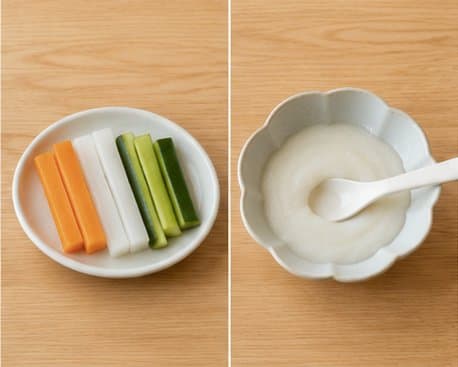
Two Philosophies of Starting Solids
If you have spent any time in English-language parenting circles, you have probably encountered baby-led weaning (BLW) - the approach where babies skip purees entirely and self-feed soft finger foods from the start. In Japan, the dominant approach is quite different: rinyushoku is spoon-fed, stage-based, and begins with smooth purees that gradually increase in texture.
Parents often ask me which is "better." Having trained as a dietitian in Japan and watched both approaches closely, my honest answer is that both can work well, and the most sensible path for many families borrows from each.
What Each Approach Looks Like
Baby-led weaning skips purees. From around six months, the baby is offered soft, graspable pieces of food - steamed vegetable sticks, soft fruit, strips of well-cooked meat - and feeds themselves from the beginning. The baby controls pace and quantity entirely.
The Japanese approach (rinyushoku) begins with smooth, spoon-fed okayu and purees in Stage 1, then steps up texture in careful stages: soft-tofu consistency in Stage 2, mashable lumps in Stage 3, and bite-sized family foods in Stage 4. Finger foods are introduced gradually alongside spoon-feeding, especially from Stage 3.
What the Evidence Actually Says
It is worth being clear-eyed here, because BLW is sometimes marketed with stronger claims than the research supports.
Choking: A common worry is that BLW increases choking. Well-designed research, including the New Zealand BLISS study (a modified, safety-focused version of BLW), found that babies following a baby-led approach did not choke more often than spoon-fed babies - provided high-risk foods were avoided and safety guidance was followed. Importantly, this required active education on safe food forms. Choking risk is really about food texture and supervision, not the feeding philosophy itself - see our choking hazards guide.
Iron: This is a genuine concern for strict BLW. Early self-fed foods can be low in iron, and babies may not eat enough of them to meet the iron needs that spike around six months. The BLISS researchers specifically recommended offering an iron-rich food at every meal to address this.
Long-term outcomes: There is no strong evidence that BLW produces less fussy eaters or healthier weights in the long run. What does matter, across every approach, is responsive feeding - reading and respecting your baby's hunger and fullness cues rather than coaxing or pressuring.
The Honest Trade-offs
Baby-led weaning - strengths: Encourages self-regulation and early chewing practice, lets the baby join family meals quickly, and is often less work (no separate pureeing).
BLW - cautions: Requires careful attention to iron and to safe food shapes; can be messy; harder to know how much was actually eaten.
Japanese approach - strengths: Texture progresses gradually and predictably; easy to monitor intake and introduce allergens one at a time; dashi-based flavours build a varied palate without salt.
Japanese approach - cautions: More preparation; finger-food and self-feeding skills need to be deliberately introduced, or a baby can become very accustomed to being spoon-fed.
My Recommendation: Combine Them
In practice, the families I see do best are not purists. A blended approach captures the strengths of both:
- Start with spoon-fed purees for clear texture progression and easy allergen introduction, the Japanese way.
- From around Stage 2-3, offer safe finger foods alongside the spoon - soft steamed vegetable sticks, small pieces of well-cooked fish, strips of baby udon - so your baby builds self-feeding and chewing skills.
- Make sure an iron-rich food features at most meals, whichever method you lean on.
- Above all, feed responsively: offer good food, and let your baby decide how much.
This is, in fact, close to how modern Japanese guidance has evolved - retaining the stage-based texture progression while encouraging hand-held foods and self-feeding ("tezukami-tabe") from the late middle stage onward.
A Note From My Own Experience
I leaned Japanese with my daughter - spoon-fed okayu and purees - largely because it was what I knew and what let me track her allergen introductions cleanly. But somewhere around nine months, I noticed she desperately wanted to grab things herself. The day I handed her a soft-steamed carrot stick instead of bringing the spoon to her, her whole face changed. She felt in control.
That was the moment I stopped thinking of it as one method versus another. She needed the structure of stages and the autonomy of self-feeding. Most babies, I think, do.
What to Read Next
- When to Start Solids - The Japanese Approach to Beginning Baby Food
- Choking Hazards in Baby Food - A Stage-by-Stage Safe Foods Guide
- Iron-Rich Japanese Baby Foods - Preventing Iron Deficiency During Weaning
- Stage 3 Baby Food - The Japanese Approach to 9-11 Month Feeding
Yumi is a registered dietitian (管理栄養士) and certified school nutrition teacher (栄養教諭) with 7.5 years of experience planning school lunches in Japan. She is now a first-time mother navigating rinyushoku with her own daughter, applying everything she has learned - and discovering how different it is when the baby is yours.
Sources:
- Daniels L et al., "Baby-Led Introduction to SolidS (BLISS) study," BMC Pediatrics, 2015; and Fangupo LJ et al., choking outcomes, Pediatrics, 2016
- Ministry of Health, Labour and Welfare, Japan. Enyuushoku Shien Guide (Weaning Support Guide), 2019
- Brown A, Jones SW, Rowan H, "Baby-Led Weaning: The Evidence to Date," Current Nutrition Reports, 2017
- American Academy of Pediatrics, "Starting Solid Foods," HealthyChildren.org